
Introduction
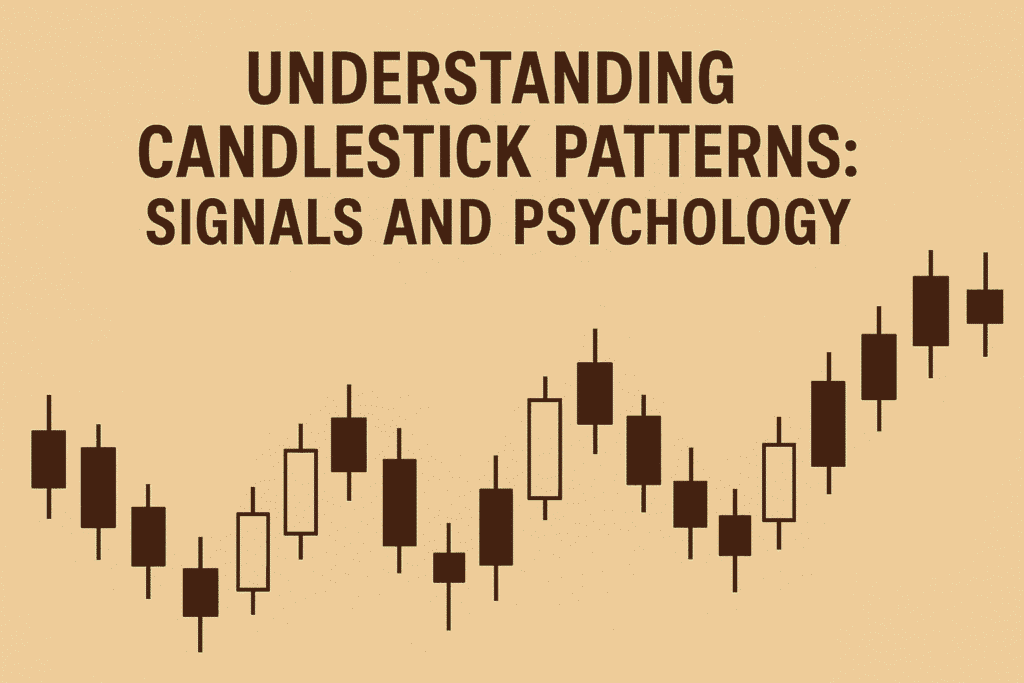
Candlestick charts are among the most powerful tools in forex charts analysis. They visually represent how price reacts within a given timeframe, revealing the underlying emotions driving the market—fear, greed, confidence, or hesitation. Understanding candlestick patterns forex allows traders to interpret market psychology, recognize potential reversals, and improve their decision-making through price action reading.
This guide explores key candlestick patterns, their psychological meaning, and how to apply them effectively within a broader chart analysis framework. For foundational chart interpretation techniques, refer to our Comprehensive Guide to Forex Charts and Price Action.
What Are Candlestick Patterns?
Candlestick patterns are visual representations of market sentiment based on price movement. Each candle reflects four data points — open, high, low, and close — giving insight into who dominated the session: buyers or sellers.
- Body: The area between open and close prices.
- Wicks (or shadows): Show the highest and lowest prices reached.
- Color: Green or white indicates bullish momentum; red or black indicates bearish pressure.
When several candles form together, they create repetitive price structures that reflect trader psychology. These visual clues are the essence of forex chart analysis, helping traders anticipate market direction before indicators confirm it.
For more about interpreting overall chart structures, explore our Comprehensive Guide to Forex Charts and Price Action.
The Psychology Behind Candlestick Patterns
Every candle is a snapshot of trader emotion—optimism, hesitation, panic, or confidence. The market is a reflection of crowd behavior, and candlestick formations visualize this tug of war.
- Long bullish candles: Confidence and strong buying momentum.
- Long bearish candles: Fear or heavy selling pressure.
- Small candles: Uncertainty or lack of conviction.
- Long wicks: Price rejection zones showing hesitation.
Understanding these cues helps traders interpret the price action reading behind the market’s moves, providing deeper insight than indicators alone.
Major Candlestick Patterns and Their Meaning
1. The Doji — Balance and Indecision
A Doji forms when the open and close are nearly equal, producing a thin body. It represents equilibrium between buyers and sellers and often precedes trend reversals.
Variations:
- Standard Doji: Neutral market sentiment.
- Dragonfly Doji: Long lower wick—possible bullish reversal.
- Gravestone Doji: Long upper wick—potential bearish reversal.
Doji patterns near support or resistance carry extra weight in chart analysis, especially when confirmed by subsequent candles.
2. Hammer and Hanging Man — Early Reversal Signals
These two patterns share similar shapes but opposite meanings based on placement.
- Hammer: Appears after a downtrend; suggests buyer re-entry.
- Hanging Man: Appears at the end of an uptrend; signals exhaustion.
Both candles show emotional battles — fear turning into confidence or vice versa. When combined with price action reading and support/resistance mapping, these become powerful reversal indicators.
3. Engulfing Patterns — Shifts in Market Sentiment
The Engulfing Pattern consists of two candles, where the second completely engulfs the first.
- Bullish Engulfing: Buyers overpower sellers.
- Bearish Engulfing: Sellers seize control.
The psychology behind this pattern shows a decisive power shift. The larger the engulfing candle, the stronger the conviction. Integrating this with forex charts trendline analysis improves reliability.
4. Morning Star and Evening Star — Momentum Transitions
These three-candle patterns show gradual shifts in momentum:
- Morning Star: Bearish → indecision → bullish reversal.
- Evening Star: Bullish → indecision → bearish reversal.
They reveal how sentiment changes over time — a crucial element of price action reading.
To understand these in broader trend context, review trend continuation setups in the Comprehensive Guide to Forex Charts and Price Action.
5. Shooting Star and Inverted Hammer — Market Exhaustion
Both feature small bodies and long upper wicks.
- Shooting Star: Appears at trend tops — failed bullish breakout.
- Inverted Hammer: Appears at trend bottoms — early buyer re-entry.
These show exhaustion in one direction and foreshadow reversals. They’re most effective when confirmed by chart analysis and multi-timeframe confluence.
Using Multiple Candlestick Patterns Together
Patterns gain strength when they align. A Doji followed by a Bullish Engulfing or a Hammer confirmed by a Morning Star creates strong confirmation of trend change.
Combining multiple formations aligns with advanced forex charts methodology — understanding how patterns interact with market structure, not just isolated candles.
Learn how to combine candle formations with breakout and retracement zones in our Comprehensive Guide to Forex Charts and Price Action.
Candlestick Patterns in Different Market Conditions
Candlestick effectiveness varies by market type:
- Trending Markets: Use continuation signals (Engulfing, Morning Star).
- Range-Bound Markets: Focus on reversal setups near boundaries (Doji, Hammer).
- High Volatility: Long wicks show rejection — ideal for reversals.
- Low Volatility: Short candles precede breakouts.
Adapting analysis based on volatility is part of professional chart analysis, ensuring patterns are interpreted within context rather than in isolation.
Confirmation Is Key
Candlestick signals are powerful but must be validated.
Ways to Confirm:
- Next Candle Close: Confirms follow-through.
- Volume: Increased participation validates breakouts.
- Indicators: RSI or moving averages confirm divergence or continuation.
- Multi-Timeframe Check: Align signals across daily and 4H charts.
- Fundamentals: Avoid trading against major news events.
Confirmation transforms price action reading from guesswork into evidence-based decision-making.
Common Mistakes When Using Candlestick Patterns
- Trading every pattern blindly.
- Ignoring trend direction or structure.
- Over-trading short timeframes.
- Neglecting volume confirmation.
- Expecting perfect reversals.
Remember, candlesticks are context clues — not guaranteed signals. Their strength lies in how they fit within forex charts and overall market sentiment.
Practical Case Studies: Candlestick Psychology in Action
Case 1: Bullish Engulfing After Downtrend
EUR/USD forms a Bullish Engulfing near support with a spike in volume. A subsequent higher close confirms reversal — textbook example of crowd psychology shifting.
Case 2: Gravestone Doji at Uptrend Top
GBP/JPY forms a Gravestone Doji after a strong rally. The next candle opens lower, signaling selling pressure.
Case 3: Morning Star Before Breakout
AUD/USD prints a Morning Star formation after repeated rejections, confirming accumulation before a breakout rally.
These setups showcase real-world applications of candlestick patterns forex, emphasizing emotional reactions behind each market move.
Multi-Timeframe Candlestick Analysis
Professional traders combine multiple chart timeframes to strengthen conviction.
- Identify the primary trend on the daily forex chart.
- Confirm reversal or continuation patterns on the 4-hour chart.
- Execute entries using 1-hour or 15-minute patterns.
This multi-layered approach provides macro perspective and micro precision — an essential element of advanced chart analysis.
Learn multi-timeframe alignment techniques inside our Comprehensive Guide to Forex Charts and Price Action.
Integrating Candlestick Patterns With Broader Chart Analysis
Candlestick analysis should never exist in isolation. It becomes most powerful when integrated with:
- Trendlines and support/resistance mapping
- Fibonacci retracements
- Volume and breakout levels
- Chart formations like triangles or flags
This integration creates a complete price action reading ecosystem that allows traders to forecast moves with high confidence.
Together with the Comprehensive Guide to Forex Charts and Price Action, this cluster forms a unified framework for technical mastery — merging pattern recognition with overall chart context.
Candlestick Psychology and Emotional Balance
The best traders don’t just read patterns; they understand the psychology behind them.
A long bullish candle represents optimism and fear of missing out (FOMO), while a strong bearish candle reflects panic and loss aversion. Recognizing these emotional forces helps traders align themselves with crowd behavior rather than against it.
Developing emotional balance and patience ensures traders act on confirmed chart signals rather than impulses.
Conclusion
Candlestick patterns remain one of the most accessible yet sophisticated ways to interpret forex charts. They bridge technical analysis with human psychology, translating emotion into visual form.
By mastering price action reading and combining patterns with multi-timeframe confirmation and chart analysis, traders gain a professional edge.
Use this article alongside our Comprehensive Guide to Forex Charts and Price Action to build a complete understanding of chart behavior — from individual candles to complex price structures.
Every candle tells a story. The more fluently you learn to read them, the clearer the market’s message becomes.