
Quick answer: there is no single “best” gold trading strategy — trend-following, range-trading, breakout, and fundamentals-driven approaches each suit different market conditions, and most traders who last do one or two of them well rather than all four badly.
Gold trading strategies built for currency pairs don’t always transfer cleanly to gold, because gold isn’t driven by two countries’ interest-rate differentials the way a forex pair is. It responds to real (inflation-adjusted) US Treasury yields, the strength of the US dollar, and shifts in safe-haven demand, often all at once. A strategy that ignores that context tends to work until the macro backdrop changes, then stops working without warning.
Why Gold Needs Its Own Strategy, Not a Borrowed One
Gold doesn’t move on interest-rate differentials the way a currency pair does — it responds to real US yields, dollar strength, and safe-haven demand, often at once, and a technical setup that ignores that context can get blindsided by a headline with no warning on the chart. (If you’re specifically trading within a single session, our intraday gold trading strategy guide covers when in the day that liquidity actually shows up.)
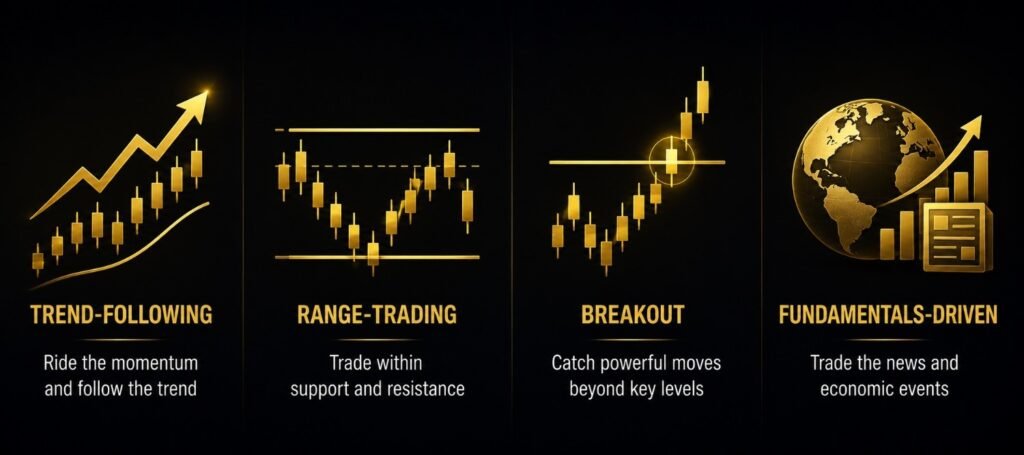
1. Trend-Following
Trend-following treats gold’s direction as more likely to continue than reverse once it’s established. The mechanics are straightforward: use a moving average (or a pair of them) to define the prevailing trend, then look for entries in that direction on pullbacks rather than trying to pick the exact top or bottom. Our guide to SMA vs EMA covers how to choose between the two for this purpose.
Trend-following works best when gold is in a sustained macro move — for example, a multi-month stretch of falling real yields — and works worst in a choppy, range-bound market, where moving-average crossovers generate repeated false signals.
2. Range-Trading
When gold isn’t trending, it’s often oscillating between a defined ceiling and floor. Range-trading strategies buy near the floor and sell near the ceiling, using prior swing highs and lows to define those levels. A Fibonacci retracement can help identify likely reaction zones inside an established range, though it works as a probability tool, not a guarantee that price reacts there.
The main risk with range trading is holding onto the “it’ll bounce like it always does” assumption after the range has actually broken — which is why every range trade needs a clear invalidation level outside the range, not just inside it.
3. Breakout Trading
Breakout strategies aim to catch the start of a new trend as gold clears a well-established range or chart pattern. The central challenge is telling a genuine breakout from a false one — a brief spike outside the range that reverses within the same session. Two things help filter for genuine breakouts: confirmation on a closed candle rather than an intra-bar touch, and checking that the breakout is happening during a liquid session rather than a thin one — thinner sessions such as the Asian window are widely reported by traders and broker education resources to produce more false breakouts, though this is a general tendency rather than a guaranteed rule.
4. Fundamentals-Driven Trading
Rather than trading price action alone, a fundamentals-driven approach positions around the macro drivers described above: real yields, dollar strength, and safe-haven flows. This is a slower-moving, higher-conviction style — it isn’t about catching every session’s move, but about being positioned correctly for a multi-week or multi-month macro theme (for example, a shift in central bank rate-cut expectations). It pairs naturally with a longer holding period than the other three approaches, and with wider stops that give the position room to work.
Matching a Gold Trading Strategy to Your Time and Risk Tolerance
| Strategy | Best market condition | Typical holding period |
|---|---|---|
| Trend-following | Sustained directional move | Days to weeks |
| Range-trading | Sideways, well-defined ceiling/floor | Hours to days |
| Breakout | Coiling price action near a key level | Hours to days |
| Fundamentals-driven | A clear macro theme in play | Weeks to months |
Traders with limited screen time generally do better with trend-following or fundamentals-driven approaches, since both tolerate checking in less frequently. Range and breakout strategies typically demand more active monitoring, since the entry window is narrower. If your goal is specifically to day trade — closing every position the same day — our day trading gold guide covers instrument choice and the daily risk rules that style needs.
Risk Management: The Part Most Gold Trading Strategies Get Wrong
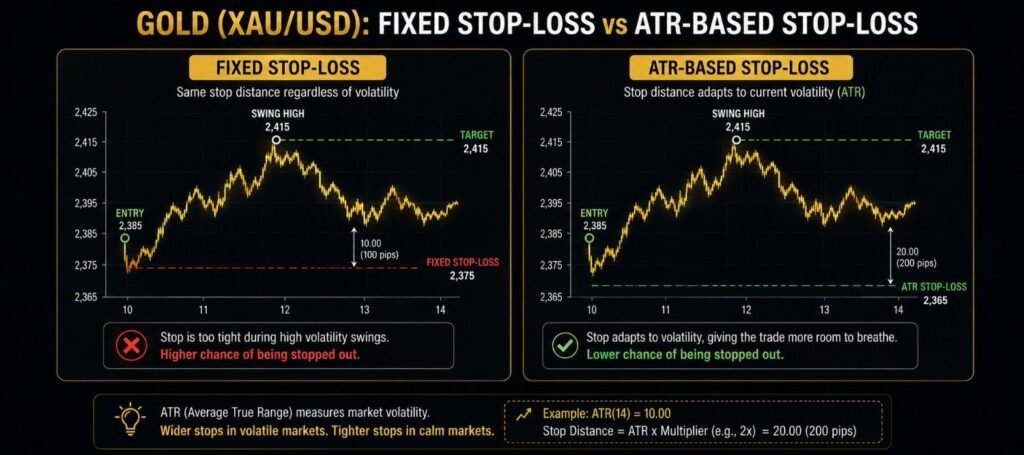
The strategy type matters less than how the position is sized and where the stop sits. Gold’s daily range isn’t constant — it varies with the macro backdrop and can widen sharply around central bank decisions or geopolitical shocks — so a fixed stop-loss distance that works in a quiet month can be far too tight in a volatile one. Sizing to a volatility measure like the Average True Range, rather than to a fixed number of dollars or pips, keeps the risk taken roughly consistent across different volatility regimes.
A second risk that’s specific to gold: because it’s dollar-priced, a position can be affected by a broad dollar move that has nothing to do with the gold-specific setup that triggered the trade. Being aware of scheduled US data and dollar-driving events — not just gold-specific news — is part of managing a gold position properly.
COMEX gold futures trade on CME Globex nearly around the clock,1 which means a gold position can be affected by news breaking outside your own working hours — another reason volatility-based sizing matters more for gold than for an instrument with a fixed daily session.
Common Mistakes Across All Four Approaches
- Mixing strategy types mid-trade. Entering as a breakout trade, then holding through the reversal “because it might become a trend” — turning a defined-risk trade into an undefined one.
- Ignoring the macro backdrop entirely. A purely technical setup can still get overridden by a surprise inflation print or a shift in Fed expectations.
- Using the same position size regardless of which strategy is being traded. A fundamentals-driven position held for weeks and a breakout trade held for hours carry very different risk profiles and shouldn’t automatically use the same size.
Key Takeaways
- There’s no single best gold trading strategy — trend-following, range-trading, breakout, and fundamentals-driven approaches suit different conditions.
- Gold’s own mechanics (no yield, inverse dollar sensitivity, safe-haven flows) mean a strategy borrowed unmodified from currency-pair trading often underperforms.
- Risk sizing matters more than which strategy you pick — use a volatility measure like ATR rather than a fixed stop distance.
- Know which strategy you’re trading before you enter, and don’t let one style drift into another mid-trade.
Frequently Asked Questions
What is the most profitable gold trading strategy?
There isn’t one strategy that outperforms in all conditions — trend-following tends to do best in sustained directional moves, while range-trading suits sideways markets. Which one performs best depends on the market regime at the time, not a fixed ranking.
Is gold trading strategy the same as forex trading strategy?
The mechanics overlap (trend-following, range-trading, and breakout concepts apply to both), but gold’s specific drivers — real yields, dollar sensitivity, and safe-haven demand — mean a strategy built purely around interest-rate differentials, as many forex-pair strategies are, won’t map directly onto gold.
How much capital do I need to start trading gold?
This depends entirely on your broker’s minimums, the instrument (spot gold, futures, or a gold CFD each have different capital requirements), and your own risk tolerance — there’s no universal minimum, and starting with money you can’t afford to lose is not advisable regardless of the amount.
Can beginners trade gold strategies successfully?
Yes, but gold’s dual identity as both a commodity and a safe-haven asset makes it more complex than a simple trend instrument. Beginners are generally better served starting on a demo account in 2026, picking one strategy type rather than all four, and keeping a trade journal to track what’s actually working.
1 Source: CME Group, official COMEX Gold futures trading hours.