
Quick answer: the most reliable intraday gold trading strategy is built around the London-New York overlap, 13:00-17:00 GMT, when spreads are typically tightest and moves are most sustained.
Gold reacts to real interest rates, the US dollar, and safe-haven demand all at once — which is why a strategy that treats every hour of the trading day as equal usually underperforms one built around when liquidity actually shows up. According to CME Group, COMEX gold futures trade on CME Globex nearly around the clock, but “open” and “actively moving” are two different things, as this guide covers in detail below.
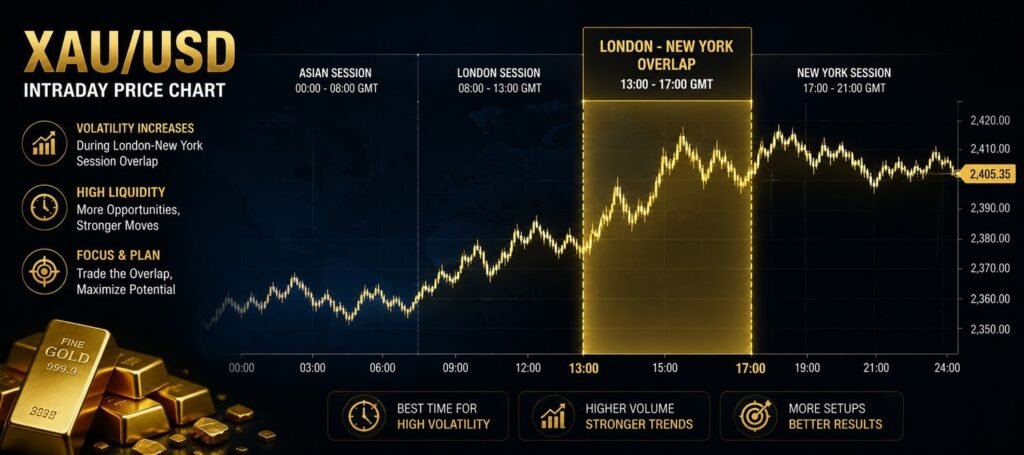
When Gold Actually Trades: Session Hours That Matter
Spot gold (XAU/USD) trades nearly 24 hours a day through the forex market, but “open” doesn’t mean “active.” COMEX gold futures — the benchmark most spot-gold pricing tracks — trade on CME Globex from Sunday 6:00 PM ET through Friday 5:00 PM ET, with a daily maintenance halt from 5:00-6:00 PM ET, Monday through Thursday.1
| Session | Approx. window (GMT) | Typical character |
|---|---|---|
| Asian | 00:00-08:00 | Quietest window; tighter ranges, more false breakouts |
| London | 08:00-17:00 | Volume and volatility increase as European desks open |
| London-New York overlap | 13:00-17:00 | Both major markets active; typically the tightest spreads and largest sustained moves2 |
A simple, honest rule for beginners building an intraday gold trading strategy: if you’re trading a breakout, the Asian session is the hardest place to do it well. Thin order books there produce false breakouts more often than the London open or the New York overlap, where a move is more likely backed by real volume.
A Session-Based Intraday Gold Trading Strategy
This isn’t a guaranteed system — no intraday strategy is — but it’s a structured way to trade gold that respects how the market actually behaves rather than treating every hour as equal.
1. Mark the Asian range
Note gold’s high and low during the Asian session. This range often acts as a reference point once London opens — price frequently tests one side of it before making its real move. (See our guide to reading support and resistance levels for how to mark this range cleanly.)
2. Wait for the London confirmation
Rather than reacting to the first spike at the London open, watch whether price closes convincingly outside the Asian range on a short timeframe (5-15 minute chart). A clean break with follow-through is a stronger signal than a wick that immediately reverses.
3. Use the New York overlap for the higher-probability entries
If London has established a clear direction, the New York overlap (from 13:00 GMT) is often where that move extends — driven by US economic data, Treasury yield moves, and dollar strength or weakness. Major scheduled US data such as CPI and Non-Farm Payrolls typically lands within this window (both are released at 8:30 AM ET / 13:30 GMT); FOMC statements land later, at 2:00 PM ET (19:00 GMT), just after the overlap ends. Check an economic calendar before entering either way — gold can move sharply and unpredictably in the minutes around any high-impact release.
4. Size the position to the volatility, not a fixed number
Gold’s daily range varies meaningfully with the macro backdrop — it isn’t constant. Rather than risking a fixed dollar amount regardless of conditions, base position size on a volatility measure such as the Average True Range, so a normal daily swing doesn’t blow past your intended risk. (Our ATR and position-sizing guide walks through the calculation.)
5. Set an invalidation point before you enter — not after
Decide where the setup is simply wrong (typically the other side of the range from steps 1-2) before opening the position. Moving a stop further away because “it’ll probably come back” is one of the most common ways an intraday gold trade turns a small loss into a large one.

What Makes Gold Different From Trading a Currency Pair
- It trades against real yields, not just the dollar. Gold pays no interest, so when inflation-adjusted US Treasury yields rise, gold becomes relatively less attractive to hold, and vice versa. Dollar strength alone doesn’t always explain a gold move.
- It’s a safe-haven asset. Unexpected geopolitical or financial-stability news can move gold independently of its usual technical setup, in either direction.
- Spreads widen around news and thin liquidity. The tight spreads typical of the London-New York overlap can widen sharply in the seconds around a major data release or during low-liquidity periods like major holidays.
Common Mistakes Beginners Make Trading Gold Intraday
- Trading the Asian session breakout as if it were London. Thin liquidity produces false breakouts more often than not.
- Ignoring the economic calendar. Entering minutes before a high-impact US release and being surprised by the spread or the move.
- Using a fixed stop distance regardless of volatility. A stop that’s appropriately wide on a quiet day is often far too tight on a high-volatility day, and vice versa.
- Averaging down without a plan. Adding to a losing position because the original invalidation level was never clearly defined.
Key Takeaways
- The London-New York overlap (13:00-17:00 GMT) is typically the highest-liquidity window for an intraday gold trading strategy — tighter spreads, more sustained moves.
- The Asian session’s range is a useful reference point, not a place to chase breakouts.
- Size positions to current volatility (e.g., ATR), not a fixed number — gold’s daily range isn’t constant.
- Set your invalidation level before entering, and check the economic calendar before trading through a major US data release.
Frequently Asked Questions
What is the best time of day to trade gold intraday?
The London-New York overlap, roughly 13:00-17:00 GMT, is generally considered the most liquid window, with tighter spreads and larger sustained moves than the Asian session.
Is intraday gold trading suitable for beginners?
It can be, but gold’s reaction to yields, the dollar, and safe-haven flows makes it more complex than a simple trend-following instrument. New traders should practice on a demo account and use small position sizes before trading live.
How much can gold move in a single day?
Gold’s daily range varies with the macro environment and news flow — it isn’t fixed. Check a live volatility measure (like the Average True Range) for current conditions before sizing a position.
Does gold trade 24 hours a day?
Spot gold trades nearly continuously through the forex market, and COMEX gold futures trade on CME Globex from Sunday evening through Friday evening ET, with a short daily maintenance halt.
Building This Into a Full Trading Plan
The session-based intraday gold trading strategy above is a framework, not a finished trading plan — it tells you when to focus your attention, not what to do with every setup that appears in that window. Before trading it live, most beginners are better served by testing the approach on a demo account through at least a few weeks of different market conditions in 2026, including at least one high-volatility week around a major central bank decision, so the plan is validated against real conditions rather than a single quiet stretch. Keep a simple trade journal — session, entry reason, invalidation level, and outcome — so you can tell whether the strategy is actually working for you, rather than relying on memory or a handful of standout trades.
This guide focuses on when gold moves; if you want the broader picture of how to trade it once you’re in the right window, our gold trading strategy guide compares trend-following, range-trading, breakout, and fundamentals-driven approaches. And if you’re specifically planning to day trade — closing every position the same day, with the instrument choice and risk rules that involves — see our day trading gold guide.
1 Source: CME Group, official COMEX Gold futures trading hours. 2 Session-overlap volatility pattern is a widely documented characteristic of gold/XAUUSD trading, consistent across multiple broker education resources.