
Quick answer: day trading gold starts with picking the right instrument for your capital and goals (spot/CFD vs. futures), then building a repeatable technique and daily risk rules around it — not with searching for a single “best” indicator.
What “Day Trading Gold” Actually Means
Day trading means opening and closing positions within the same trading day, without holding overnight. That distinguishes it from swing trading (positions held days to weeks) and from ultra-short scalping (positions held seconds to minutes). Day trading gold typically means taking one to a handful of trades per session, each closed out before the day ends, rather than either a single multi-week macro position or dozens of rapid-fire scalps.
If you’re weighing day trading against those other styles, our gold trading strategy guide compares trend-following, range-trading, breakout, and fundamentals-driven approaches more broadly.
Choosing Your Instrument: Spot Gold, CFDs, or Futures
The instrument you pick shapes almost everything else about how you day trade gold — position sizing, costs, and even which hours matter most.
| Instrument | Structure | Expiration | Typical cost |
|---|---|---|---|
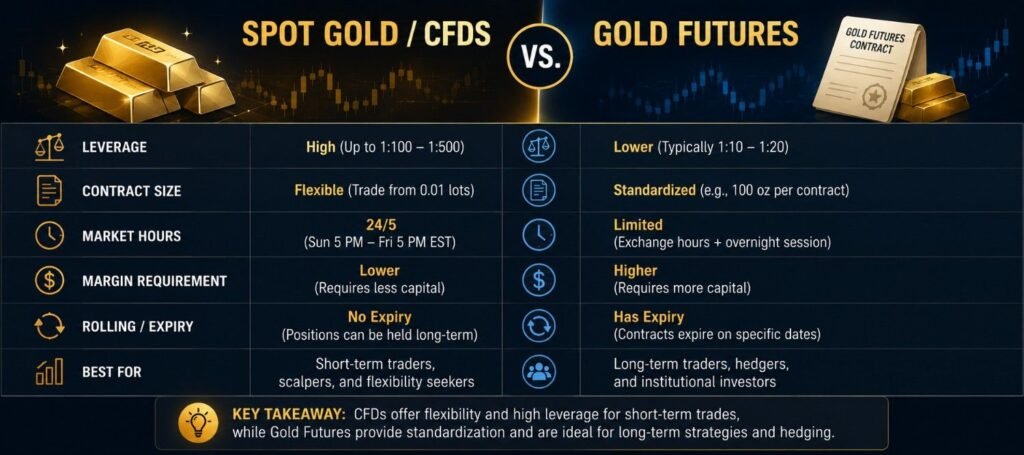
| Spot gold (XAU/USD) | Over-the-counter, priced against the dollar | None — hold as long as you want | Spread + overnight swap fee if held past daily rollover |
| Gold CFD | OTC contract with your broker tracking the underlying price | None | Spread + overnight swap fee |
| COMEX gold futures (GC) | Centralized exchange; according to CME Group, the standard contract is 100 troy ounces1 | Fixed expiry — requires rolling to a new contract to stay in the position | Commission + exchange fees; no overnight interest charge, but roll costs apply |
Spot gold and CFDs let you trade far smaller position sizes than a full futures contract, which is part of why many retail day traders start there. Futures trade on a regulated, centralized exchange with a transparent order book, which some traders prefer for that reason alone — but they come with contract expiration and roll mechanics that spot/CFD trading doesn’t have. Neither structure is inherently “better” for day trading gold; the right choice depends on your account size, your broker or futures access, and whether you’re comfortable managing a contract roll.
What You Need Before You Start
- A charting platform with fast execution. Day trading gold means acting within minutes of a setup forming — a platform with delayed data or slow order execution works against you regardless of how good the underlying technique is. Our guide to choosing a trading platform covers what to check before committing to one.
- A demo account and a testing period. Before risking real capital, test your technique across different volatility regimes — a quiet range-bound week and a high-volatility news week behave very differently, and a technique that only works in one isn’t ready.
- An economic calendar. Gold reacts to scheduled US data (inflation reports, employment data, Fed decisions), and knowing what’s due today is part of the daily routine, not an afterthought.
- A trade journal. Recording entry reason, size, and outcome for every trade is how you find out whether your day-trading technique is actually working, rather than relying on memory of the wins.
A Practical Day-Trading Technique: The Opening Range
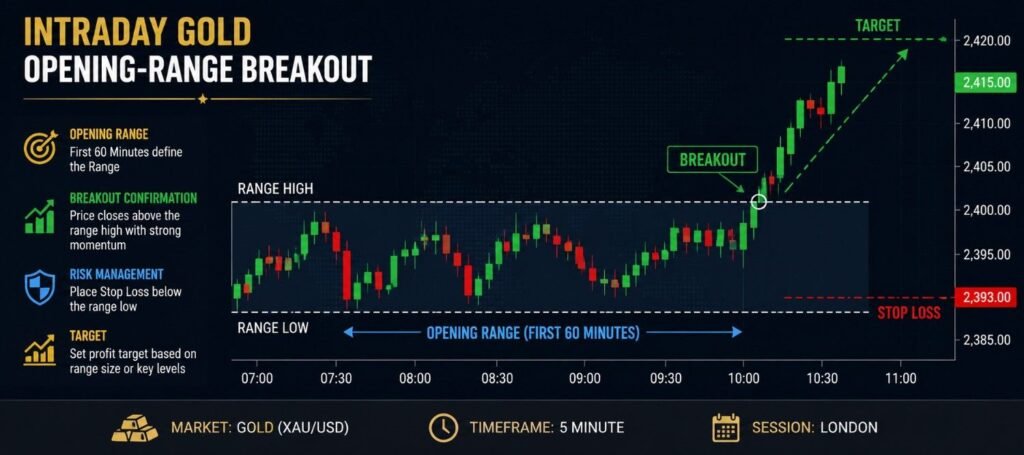
One structured way to day trade gold is the opening-range approach: mark the high and low gold trades in the first 15-30 minutes after the London or New York session opens — the two sessions where gold sees its heaviest volume, as covered in more depth in our intraday gold trading strategy guide, then watch for price to break that range with a confirmed close, rather than a brief wick through it. A break above the range can signal buying pressure building; a break below can signal the opposite. Like any single technique, it works better in a trending environment and produces more false signals in a choppy one — which is why pairing it with a basic check of the broader trend (not just the opening range in isolation) tends to filter out some of the weaker signals. Momentum indicators such as RSI or MACD are a common way traders add that trend context; our guide to using RSI and MACD for entries walks through the mechanics.
Whichever technique you use, it’s worth testing on a demo account through a full range of 2026 market conditions — including at least one high-volatility week around a major US data release — before trading it with real capital. A technique validated only during a quiet stretch tells you little about how it holds up when gold actually moves.
Daily Risk Rules for Day Trading Gold
Day trading introduces a risk that longer-term strategies don’t face as acutely: the temptation to keep trading after a loss to “get it back” the same day. Three simple rules address this directly:
- Set a daily loss limit before the session starts, and stop trading for the day once it’s hit — regardless of how good the next setup looks.
- Cap the number of trades per day. A hard limit (for example, three setups) forces selectivity and reduces the temptation to force a trade out of boredom.
- Size each position to your account and the day’s volatility — see our ATR position-sizing guide for the mechanics — not to how confident you feel about a particular setup. Confidence is not a risk-management input.
Common Mistakes Day Traders Make With Gold
- Revenge trading after a loss. Entering a larger, less-planned position specifically to recover a prior loss in the same session.
- Overtrading in quiet conditions. Forcing trades during a slow session because it’s “trading time,” rather than waiting for an actual setup.
- Switching instruments mid-strategy. Testing a technique on spot gold, then trading it live on futures (or vice versa) without accounting for the structural differences in cost and expiration described above.
- No daily stop. Trading without a predefined point at which you stop for the day, win or lose.
Key Takeaways
- Day trading gold means closing every position the same day — pick your instrument (spot/CFD vs. futures) based on your capital and comfort with contract expiration, not habit.
- Test any technique, including the opening-range approach above, across both quiet and volatile weeks before trading it live.
- A daily loss limit and a cap on trades per day address the specific risk day trading introduces: revenge trading and overtrading in the same session.
Frequently Asked Questions
Is day trading gold profitable?
It can be, but profitability depends on execution, risk management, and market conditions — there’s no instrument that guarantees profit, and most day traders lose money overall. Treat any specific “X% win rate” claim you see elsewhere with skepticism unless it comes with verifiable, audited data.
Should I day trade gold with futures or CFDs?
It depends on your capital and goals. Futures trade on a centralized exchange with no overnight interest but do expire, requiring a roll. CFDs/spot gold have no expiration and allow much smaller position sizes, but typically carry overnight swap fees and OTC-style execution through your broker.
How many hours a day does day trading gold require?
There’s no fixed number, but most day traders focus on a specific 1-4 hour window rather than watching the market all day, since gold’s own liquidity is concentrated in certain sessions.
What is the opening range in gold day trading?
The opening range is the high and low gold trades in the first few minutes after a key session opens. Some day traders use a break of that range, with confirmation, as a trade signal.
1 Source: CME Group, standard COMEX Gold futures (GC) contract specification (100 troy ounces per contract).